
TRUE MAGICAL TRAVEL TALES of Dr. Art
A TALE OF TWO CITIES
TARAGAHR AND SAN FRANCISCO
As retold and written by Dr. Art Rosengarten
From India in Three Parts
Part 1
WHEN MOUNTAINS WERE MOUNTAINS
AND VALLEYS WERE VALLEYS
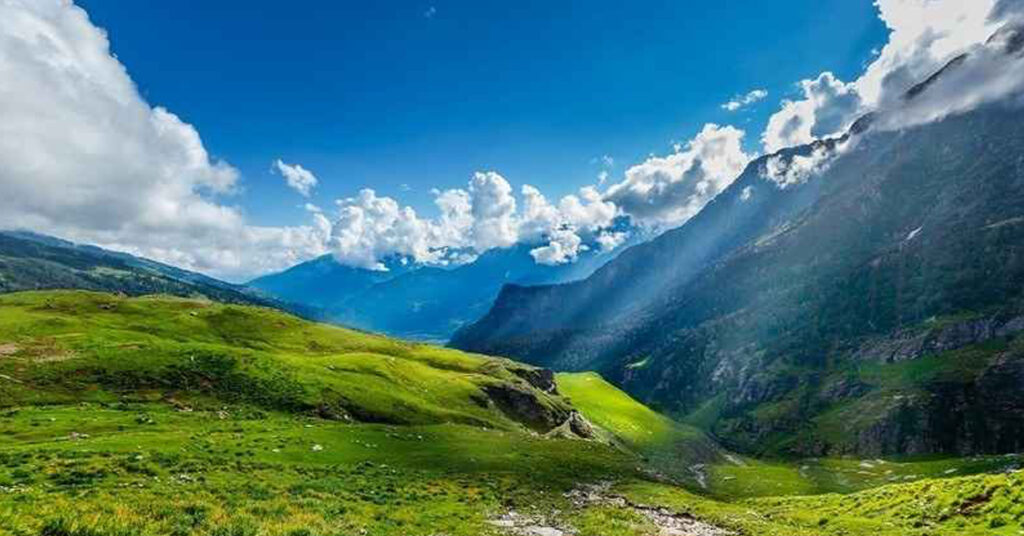
Himachal Pradesh, N. India
October 17, 1989
The background fugue of rumbling turbines had suddenly ceased. Om mani padme om. They had been droning non-stop over half the earth’s time zones like bad refrigeration—by plane vis-à-vis San Francisco to Frankfort they droned, and then droned on to New Delhi; by sleeper train they rumbled and droned from Old Delhi to the verdant hills of Kashmir/Jammu, first Himalayan state of India; by chartered bus they shook, rattled, and droned for the eight hour excursion into the magnificent mountain state of Himachal Pradesh, situated in the splendid heart of the western Himalayas. Now, mercifully, all droning of modern engines had ceased to exist. It was nirvana. The stillness of the cool sun-filled morning was a raga of pure silence.
The adventure had actually begun the week prior as thirty of us set out from the San Francisco International Terminal. A mixed bag of Bay Area grad students and professionals–dressed-down religion professors, cultural anthropologists, and transpersonal psychology types like myself– plus the usual fare of meditation junkies, tough dharma feminists, and sundry Eastern spiritual seekers. We had all signed on for a two-month pilgrimage devoted to the study of Mountain Goddess cults of Northern India and Tibet sponsored by the California Institute Of Integral Studies. Besides daily classes and meditation instruction from an impressive faculty of Asian philosophy scholars, a full itinerary of day trips to ancient sacred temples and points of interest was also prearranged for our convenience, including what promised to be a highpoint of the trip: a private audience in several weeks with His Holiness, The Dalai Lama at his McLeod Gang residence in Upper Dharamsala, only an hour’s drive away. His Holiness, ironically, was himself currently in California to be honored as the 1989 recipient of the Nobel Peace Prize. Small world.
We were all simply pleased, ecstatic in fact, to finally be able to sit back and breath mindfully like the American dharma students we aspired to become; passage through India had been exotic but draining. If Indira International Airport in Delhi now seemed weeks ago when it was only days, then San Francisco International was but a fleeting memory of the other universe we once inhabited. It’s remarkable how quickly one forgets the other side, which vanishes from memory like a dream after each awakening.
Our final destination was the small Himalayan village of Taragarh. In contrast to the travel lows of previous days–most notably the unforgettable Old Delhi Station (a dark, soot-filled, endless maze of underground tunnels, butter lamps, tea stands, and sleeping untouchables, known for the occasional random nail bomb explosion and generally saturated with the lower smells of death, distinctly reminiscent of Hell); by comparison, the exalted presence of Taragarh was like the mythical mountain kingdom of Shambhala—believed, by Tibetan legend, to be the only pure land which exists on earth. It was indeed a higher octave of consciousness one senses instantly, like going to bed exhausted in Hoboken and waking up refreshed in the Garden of Eden.
Within India itself, one sees the difference of two worlds in the dogs. Indian dogs (barking weasels really) fend for themselves on alley scraps, rodents, and the squalor of the street or village. They are mangy, gnat-infested, and nearly feral like their canine brothers and sisters throughout much of The Third World. On the other hand, in the small Tibetan enclaves of Northern India the dogs are calm, friendly, well-fed, and Scoobyesque, and one even contemplates whether they are endowed with some canine form of Buddha nature, or so it appeared in their midst.
The Palace of Taragarh
As our private tour bus slowly entered the stately iron gates of our temporary new home–The Palace Motel–summer residence of the Maharaj and Hindu Royal Family of Kashmir, I could have pinched myself from the elation, but this was no dream in the conventional sense. The Palace was situated on a 15 acre forested estate surrounded by tea gardens in the Kangra valley, one of the most scenic and unexplored areas of Himachal Pradesh.
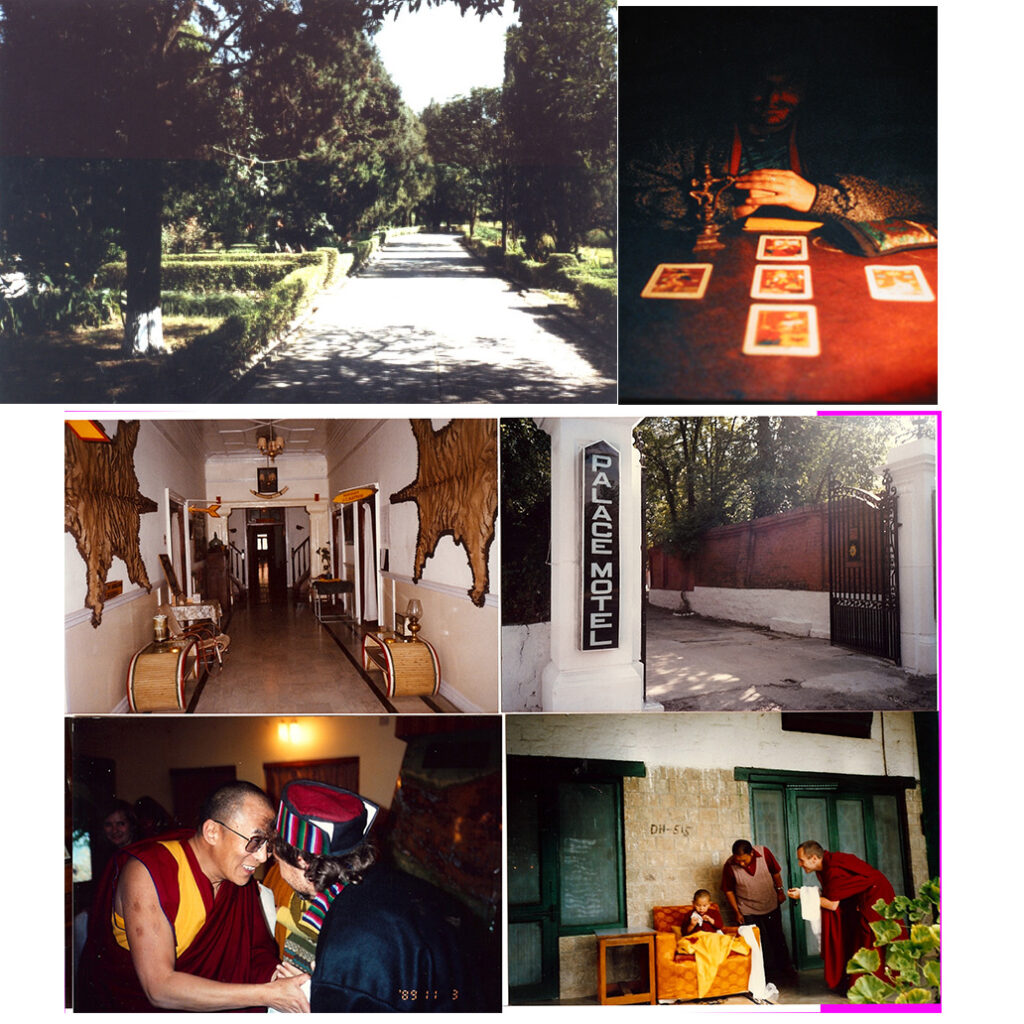
with Padre, in Dharmsala, Himachal Pradesh, 1989
Located at a modest seven thousand feet, Taragarh was at the base of the Dhauladhar mountains offering a magnificent view of the snow capped peaks. Fortunate connections in Bay Area “spiritual circles” had secured this lofty perch for us to assemble a temporary “school” of sorts, whose mission it was to encounter the mystically-fabled “Goddess of The Mountain.” But yes, this was also very much a dream as well, though in no way should this fact diminish its living emanation, as in the Eastern view all phenomenal existence, even the home in which one dwells, is ultimately no different than a phantom state or dream born of Mind.
“The Palace,” as we called it, was replete with a dozen Indian servants and cooks, showcasing long hallways of wooden floors and walls adorned with authentic Bengali tiger skins; it had a tastefully decorated private library with contemporary paintings of the local artist Sobha Singh, and many family photographs of the Maharaj’s wife, the Maharani Tara Devi, and her son Dr. Karan Singh, the famed Indian diplomat born the Crown Prince and only son of the Maharaj of Kashmir. There was a large kitchen and elegant banquet room where meals were semi-formally served on schedule.
Unfortunately for me, the thrice daily-fare of rice and dahl soon grew oppressive and in time, I would learn to hike up to Tashi Jong, the neighboring Tibetan monastery, where in the late afternoon delectable yak momos and banana lassis could be purchased for several rupees in the local enclave, tasting to my American palate something like a beef burrito chased with an Orange Julius. Marc, my Jewish Buddhist inventor friend and colleague, equally unthrilled by the monotonous menu, had presciently socked some five pounds of dark Swiss chocolate into his backpack, and generously supplemented our redundant lunches with a small but thick one inch square.
Two well-cushioned sitting rooms that adjoined the banquet hall were ideal for midday black tea, biscuits, and lively discussion. “Padre,” as we called the Ven. George Churinoff, a former M.I.T. physicist turned Gelupa monk for the past thirty years, preferred to lead his 6 a.m. Green Tara Meditations in this cozy setting for any who cared to join him. Not a morning person by nature, but meaning no disrespect, I managed to practice my guru transmissions with “The Mother of All The Buddhas,” about three times per week, figuring if necessary I could always squeeze in a short nap during the Changing Roles Of Modern Indian Women Seminar, an elective offered Tuesdays and Thursdays before afternoon tea.
Upstairs were our private quarters, perhaps fifteen double rooms, with adjoining baths (where a fresh bucket of boiling water kindly awaited us for each morning’s sponge bath). I quickly hooked up with Arjun, a dark and wiry Freudian psychologist from Redwood City (oddly, the only among us of Indian descent), after having previously shared a berth with him on the sleeper from Delhi to Jammu. Deborah, a thin attractive Zen therapist from Sonoma, and Janet, a tall and humorous lesbian from Berkeley, took the room opposite, and quickly became part of our late night revelries, gossip, and conversation.
Outside, the luxurious gardens and grounds of the Palace were peaceful and lush with exotic beauty. Snow-capped mountains in the distance could be spied through the mighty trees and shrubs that surrounded the perimeters, and a beautifully shaded lawn area became the reserved classroom site of our daily workshops in a circle of lawn chairs. The climate was indeed heavenly in mid-October, soft blue skies, impressive cloud formations in the distance, and perfect mid-70’s mountain air. We were told there was even a small private Shiva temple on the property, used in the summer by the Royal Family, and now made available for our own purposes.
Hardly bad for a single, 39 year old Tabugian therapist, I thought, even though the Tabugian model as such was merely incubating in its infancy state. The new group was friendly enough, and I anticipated many extraordinary things would come of this. There were some attractive and interesting people I hoped to get to know deeply, the majority my own age and mostly female, and a handful of world-class scholars and spiritual teachers were assembled to be our guides. I had come to India seeking for the mystical, but was packed for the magical. Two months of supplies (in one suitcase and backpack) amounted to the barest of modern essentials: one jacket and three sets of loose-fitting clothes, hiking boots, running shoes, rayon underwear, lots of socks, malaria medicine, antibiotics, one snakebite kit (which I had no interest in opening), two tubes of sunblock and insect repellent, a few empty journals, camera and lots of film, 6 pens, a Krishnamurti paperback, some lucky talisman of a personal nature, and of course, two decks of cards.
I was glad I had brought several Tarot decks, no matter their reputed Western Renaissance origins, if only to see how the magic would be affected in this rare company and at these rarified altitudes. Wisely, I had packed not only a commonplace deck of Waite miniatures, but also a rare collector’s set of 22 Oswald Wirth Majors, impeccably rich in color with 19th century Marseille-style symbol conventions and French Titles; they were given to me years earlier by an antique dealer and old friend named Richard from New Jersey. I had only used them previously for especially arcane and lofty occasions. Encountering the Himalayan Mountain Goddess, I mused, must qualify. I sensed that they too, my precious tarots, would gain in merit from her radiant presence.
Bad Omen On Opening Day
I quickly dropped my bags on my bed, changed into a pair of shorts and sandals, and headed excitedly down the long tiger-skinned hallways and through the front entrance to the Palace gardens—it was free time to play on opening day. I put a music tape in my headset and set out to explore. Some forty minutes later, I was approaching the aforementioned Siva temple that stood off by a remote end of the twenty-acre property, facing the distant pine forests in the background above. One arrived there naturally, like all roads leading to Rome, as it marked the end of several footpaths through the splendid orchards behind the estate, and intuitively seemed to call one to it.
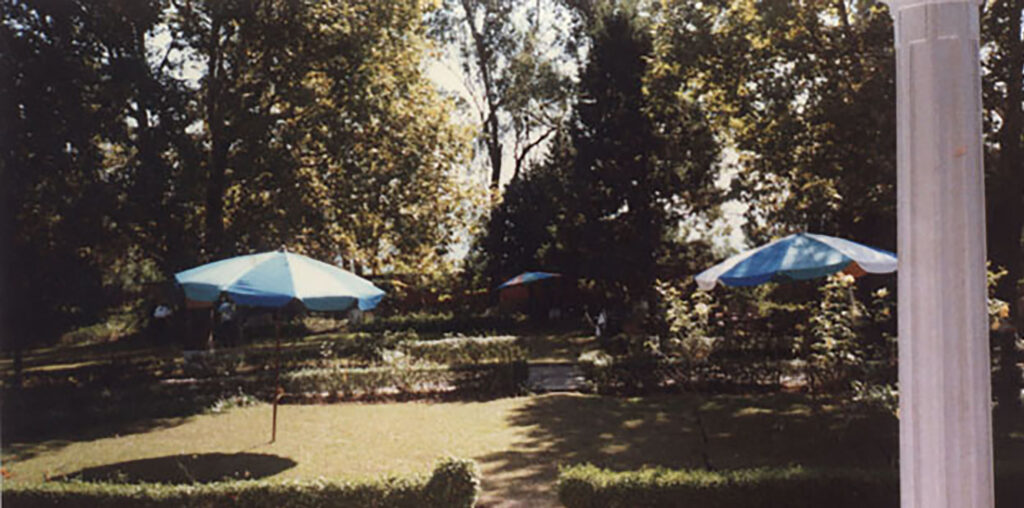
Wild parrots could be heard singing from the huge sycamore trees nestled around the hidden, overgrown grove that surrounded it. It is said that devotees of the Hindu God Siva, cosmic dancer and divine Lord of Destruction, worship not so much his many names and forms, as his over-riding dynamism or “cosmic stream of fleeting evolutions” which continually produce and extinguish individual existences. Mountains and valleys, life/death, hope/despair etc. were merely the daily food this Hindu Deity devoured for breakfast and spit out for lunch. My kind of God, I thought, especially now.
Outside the small temple garden, straddling a low red brick wall, were congregated some ten or twelve casually dressed, busily chatting “individual existences” from Northern California, meandering this holy ground like sacred cows on unpaved village streets. About a third of our entire entourage was there, some five men and seven women– joking, gyrating, trading stories in the intoxicating air. Some wore their bright and exotic Indian designs freshly gobbled up in the bazaars of New Delhi. The American banter, to me at least, seemed strangely out of place for this secluded corner of the Universe, which was as alien and far away from home as we West Coast “gringos” were ourselves.
As I was late on the scene, my arrival to the temple pleasantries went hardly noticed and I sort of slipped in to the gathering. However, there was now tension in my belly. Despite the bright spirits of my peers, I felt like a dark cloud covering the peaceful skies of a summer picnic. As fate would have it, I had minutes earlier been “volunteered” for the rather unfamiliar role of bearer of bad news. Bad news? Like what? Not even I had a clue, for my given task was merely that of “messenger courier”—like the innocent server of a bad subpoena.
While casing the Palace grounds, wide-eyed and naturally intoxicated, I had stumbled upon a small gathering of core faculty and retreat organizers convening outside the portico of the Main Estate of The Palace. Judging from their grumbling and intensity as I walked by, I knew something unexpected was up. Their mood was clearly out of synch with the mountainous aura that framed this otherwise blissful setting. I, of course, was plugged into my Sony Walkman and filled head-to-toe with the throbbing syncopation of sky and music; I vividly recall at that moment listening to a very haunting new Dylan ballad from his just released “Oh Mercy” album, entitled “Ring Them Bells.” Little did I imagine that it would be my signature song for the events that were about to unfold.
John, the retreat’s leader, motioned me over to the small powwow and then in a hushed but definite tone asked (ordered) that I quickly round people up for an “important announcement” on the Palace lawn in fifteen minutes. “Make sure everybody’s there, Art,” he said unambiguously. He gave no further instructions or information. I was unsettled, to the say the least, but responded without hesitation. All would be revealed soon enough, I reasoned, as I made my way down the orchard path to the Shiva temple.
Now, approaching my new friends, I felt like some new age Vedic Page of Wands, adorned as I was, in my natty orange and red Kulu cap (something like a fez), Forty-Niner T-shirt, beige shorts and Sony Walkman strapped around my neck; Bob Dylan was now droning in my ears and out my eyes like an old Himalayan prophet. The words from the song carried an odd biblical flavor, though somehow blending perfectly with these distinctly Indian surroundings:
Ring them bells ye heathen from the city that dreams
Ring them bells from the sanctuaries cross the valleys and streams
For they’re deep and they’re wide
And the world on its side
And time is running backwards
And so is the bride.
It was I who was running backwards, ringing them bells from the sanctuaries cross the Kangra valleys and streams. But little did I know that the world was indeed “on its side.” Now in full view, I cleared my voice and raised my arms to speak:
Ah–excuse me everyone, I need to make an announcement! (I repeated it twice). May I have everyone’s attention please…
Deborah and Marc, who had been busy in conversation at first smiled as I entered, but obviously could read from my body language that I was not there to gaggle, and helped to gather others around me very quickly. I continued, now with a hint of authority in my voice:
John has just asked me to round people up immediately. He wants us all to return to the lawn area right away. (Pause) I know it sounds strange, but I think something significant has happened, though I was not told any of the details…John seemed pretty upset, as did George and Joanna. He wants to have an emergency meeting on the lawn in ten minutes and we should all head over there now.
It was not so much the words, but the incongruity of my own voice with the surroundings, which struck that moment so starkly. Vedic Page of Wands indeed. Now everyone looked puzzled, and a bit rattled. The timing felt wrong. If this was Delhi, we would have expected it. Things always seemed to malfunction there. But this was our Shambhala, we had only arrived hours earlier, and we were eagerly awaiting the opening ceremonies scheduled to begin in just a few hours, after dinner. “Give me a break,” I heard one goddess-seeker snipe, “this is a spiritually-protected space, right?” Though I didn’t say so, these were my sentiments too.
Regardless, we all immediately scurried out the Shiva Temple garden and on through the engaging dirt paths of exotic vines and luscious bushes, perhaps a ten minute jaunt, arriving at the designated lawn area in the requested time. The fifteen or twenty others of our group too were arriving at the large semi-circle of lawn chairs set out on the manicured grass in a horseshoe. Even the Indian staff and Palace servants now huddled to the side, while John and Padre were still commiserating at center stage with their backs turned. Padre held a portable radio up to his ears and was listening intently. Thoughts and emotions, I sensed, were running amok like the bonfires inside the hellish abyss of Old Delhi Train Station.
A stream of images surged my active imagination as I sat and observed the troubled scene. Had news of another major political assassination, I wondered, ala the awful Gandhi tragedies, come down the wires? It was only a week before the contentious ’89 National Elections, and this passionate land of 800 million was notorious for lots of hot stuff when elections rolled around… No, I thought, maybe it was about the retreat itself? Some change in itinerary perhaps? I wondered whether next week’s meeting with The Dalai Lama in neighboring Dharamsala, had been canceled? A great disappointment if true, but surely we could find other interesting things to do on that day? No need to spoil the party.
After all, there were many wonderfully strange and interesting Hindu and Buddhist temples and villages to explore in the area, we were in splendid company with perfect surroundings and provisions, and according to Johanna, we were officially invited to join the monks at Tashi Jong in morning chanting and meditation. How cool was that? Then another thought occurred which gave me some pause: had someone in the group taken seriously ill? That might be a real problem, especially given how far away we were to modern medical services—at least two long days of heavy travel down mountain. No doubt, there were all kinds of infectious diseases freely available to Western tourists of the sub-continent. Maybe someone… But no, there was no time left to prefigure it. The whole group now was congregating on the lawn, as the strange mystery of the first day at the Palace would now be revealed. What we soon learned, however, was indeed far stranger and more troubling than anything we had imagined.
Two:
MOUNTAINS WERE NO LONGER MOUNTAINS, VALLEYS NO LONGER VALLEYS
The Palace Gardens
Approximately 2:30 PM
An excited buzz filled the circle of lawn chairs like anxious bees surrounding the Mother Queen. Thirty or so eclectically frocked Californians now nervously gathered in the private Himalayan garden, though clearly the Palace grounds seemed no longer so elevated. A spiritual journey of a lifetime—within the halo of the Mountain Goddess– was not supposed to begin on such a tenuous note.
Professor John B., our leader, and “Padre,” as we had nicknamed George, the American purple and yellow robed Buddhist monk, were now standing center stage, each holding a portable radio to an ear that presented an eerie montage of sacred tradition clutching to modern technology. John, who was the visage of Gandalf with wizard’s beard and eloquent New Zealander accent, now raised his arms to officially speak and shortly thereafter made the following shocking announcement:
People, brace yourselves, I have some bad news to relay, and I realize the timing could not be much worse given that we are about to launch our six-week program in a couple of hours… Five minutes ago, the BBC International made an emergency announcement that a major earthquake has struck the San Francisco Bay Area in Northern California … Friends, I realize that most of you live in the Bay Area….that your loved ones are there, and your homes and your businesses as well… I’m terribly sorry to bring this tragic news to you today.
Oh my God! A major quake in the Bay Area. I was shocked. No one had even really considered that the crisis was actually back home–on the other side—in the city where we lived–only days after we departed. How strange it felt that news from San Francisco was now knocking on the remote Palace doors of Taragahr. We had left it all behind, I thought. Anxiety was starting to envelop the walls of my stomach. What did he mean by “major?” The word kept ringing in my ears. Everyone had experienced “minor” quakes, it was almost integral to California residency. Truthfully, I sort of enjoyed them like New York subways or bumper cars. But something bigger was happening here. Why would we be having an emergency meeting here over a run-of-the-mill earthquake in California? Then John continued:
People, it remains uncertain how big this quake actually was. Unfortunately, information from the States is very sketchy at this time and according to the BBC we won’t have any official confirmation of casualties for another 24 to 48 hours… I repeat, all communication lines to the Bay Area are currently down. The truth is, people, no one really knows how serious this is… However, I must tell you, honestly, that judging from preliminary reports just announced by the American Red Cross that is being broadcast around the world, there is currently reason for significant concern.
My head began spinning like a Kansas tornado in the gray skies over Oz. Memory was mixing with vertigo in the thin mountain air as I started flashing back to a much earlier time of my current incarnation: age 13, on a cold late November morning, in the suburbs of Northern New Jersey. The scene felt so real. I am sitting in my gray wool sweater in the second row of Mr. Pemberthy’s 7thgrade Social Studies class. An unexpected announcement had just been blasted over the school’s PA system by our Mr. Sterling, the white-haired, raspy-voiced principal of South Orange Jr. High. It was the single sentence that, in retrospect, would traumatize the American psyche for decades. “Students may I have everyone’s attention please. This is your principle, Ray Sterling speaking.” Everyone sort of froze as never before had the principle made an announcement over the loud speaker in the middle of a period. After a short pause, the unthinkable words came:
Boys and girls, I regret to inform you that President Kennedy was shot in Dallas Texas earlier today while driving in a motorcade. I repeat, President Kennedy has been shot! He is still alive at this time, according to the latest report, but tragically, JFK is now in critical condition at Parkland Hospital in Dallas Texas. All students must return to their homerooms immediately and prepare for early dismissal. Your families have been notified.
That was it. The Big Bang. No further explanation, no more details, just the sinking emotion of unthinkable shock. We piled out of the school minutes afterwards, some eight hundred students, shattered, silent, and overwhelmed. With a friend, I hitch-hiked up the steep mile hill to my house and eerily a taxicab actually pulled over from the passing lane and stopped to pick us up. The windows were rolled down in the front and a cold gust filled the backseat waking us up to the cold reality of this short window of time. The black man driving was weeping and cursing “the god damn suckers, they killed the president,” as reports of the unthinkable blasted over the radio. It was the first, and remains the most disturbing, of all world-altering announcements that would unfold over my lifetime.
I now tried to refocus back to the present situation. Strangely, even here in Northern India, the news had that sinking “Dallas Texas” feel. I was numb and anxious at once. Then, in a softer voice, John to the assembled group again spoke:
My friends, we’ve just learned that they are now making early estimates of catastrophic proportions… I repeat—CATASTROPHIC PROPORTIONS– of destruction in San Francisco, Oakland, Berkeley, San Mateo and the surrounding areas… People, this may in fact have been “the Big One” everyone’s been expecting for years. Fires have broken out in San Francisco and Oakland, and the Bay Bridge is reported to have collapsed… It’s unbelievable… There is also the possibility, my friends, of massive loss of life.
Tears were now flowing down his handsome, grandfatherly face, as they were over the faces of us all. Things were moving fast. At Padre’s bidding, John again turned to hear what appeared to be yet another updated report. We waited, stone quiet and consigned to this fate. John’s eyes closed and his face appeared more somber than before, as he then relayed the latest news:
Everyone, I’m deeply saddened to tell you what we’ve just learned… but according to preliminary estimates just announced over the BBC …Ten thousand people—I repeat—ten thousand people– are projected to have died today in the San Francisco Bay Area, with up to 100,000 more who are seriously injured. Evacuation procedures may be under way for the entire area. But I must reemphasize–these numbers are uncertain– we simply won’t know for another day or so the actual facts…
That was it. It was staggering. Natural disaster had struck our own hometown—and we were now continents away stranded in remote mountains on a meditation retreat. Imagine, if you can, the overwhelming paradox we were left to mentally organize—the event (as we then perceived it) was simply too close to home and simultaneously too far away from home to adequately assimilate and neatly box. The sketchiness was cruel, and the stakes were potentially enormous. Rumblings could now be heard over the chairs:
“Was the epicenter actually in the city itself?”
“ I need to contact my children, they were probably in school when it hit.”
“My husband works downtown on the 40th floor of the Pyramid Building…”
“I’m worried my mother can’t get her medications…she’s diabetic.”
“It’s three or four days just to get back to Delhi.”
“What are we supposed to do now?”
Given the vast complication of our location and circumstance in relation to the event, this last question seemed strangely the most puzzling, and relevant. What were we supposed to do now? Realistically, waiting seemed all that was available to us. It would be agonizing, but there would be no fast or easy exit out of the mountains. Our children or girlfriends or parents might be lying dead or hospitalized in San Francisco or Oakland, but we would have to wait until tomorrow to begin any search for answers.
Even if we trekked back down to Delhi, it was doubtful that transportation would be allowed anywhere near the Bay Area. There was nothing we could directly do. We simply needed time, perhaps a day or two, for the objective facts to unfold. Then, hopefully, communication would be restored, and some reasoned response could be implemented. It was an exasperating time warp of sorts, though remarkably, we now resided in an exquisitely nurturing environment that invited deep reflection over its implications. The sun was still shinning. Dinner was still to be served in a half-hour, as scheduled, followed by the ‘Goddess Invocation Ceremony’ to be led by the wonderful Buddhist teacher, Joanna Macy. The sun was still shining, and the magnificent sky still breathlessly blue, but eerily, the mountains no longer seemed like mountains, nor did the valleys seem like valleys.
Fact Versus Perception
Due largely to “global shrinkage” brought by modern technologies, word of major disaster travels virtually everywhere almost instantaneously, even back then in the antiquated pre-web days of the late 1980’s. It struck me as poignant to now see standing quietly behind our circle of lawn chairs the senior Tibetan lama at neighboring Tashi Jong Monastery, Ven. Chogyal Rinpoche, who had hiked a mile down the mountain path (with two attendant monks) to personally express his heartfelt condolences to us, the unfortunate Americans, who had just arrived from California, the site of the great calamity. And to think we well-fed, cutting-edge Americans too can be cared for as the pitied victims of misfortune through the eyes and hearts of simple Indian villagers and gentle-hearted Himalayan monks.
Eventually, the actual facts would arrive. Like most citizens on the planet, we had just gotten word of the devastating event now known as the Loma Prieta Earthquake occurring on Tuesday, October 17th at 5:04 P.M Pacific Standard Time in Northern California. The facts are now well established: the 20-second temblor was actually centered about 60 miles south of San Francisco, not within city limits as some were given to believe. It had a Richter magnitude 7.1, leading to the collapse of the elevated Cypress Street section of Interstate 880 in Oakland, the roadbed of the San Francisco-Oakland Bay Bridge, multiple building collapses in San Francisco’s Marina district, and minor damage as far south as Santa Cruz. For years scientists had predicted an earthquake would hit on this section of the San Andreas Fault and considered Loma Prieta one of the Bay Area’s most dangerous stretches of the fault. Fate, it seemed, had sparred us from the immediacy of this disaster.
But far from the catastrophic 10,000 casualties initially predicted, in point of fact only 68 deaths occurred in total, 42 in the collapse of Interstate Highway 880 alone. Likewise, in contrast to the initially reported 100,00 serious injuries, only 3,757 injuries actually took place. Still, the initial reports were hardly baseless as the earthquake was without question a major calamity, causing significant loss of life, property, and suffering to the Bay Area community. All told, 1,018 homes and 3,530 businesses were damaged, and 366 businesses were destroyed. The estimated dollar loss was 6 to 7 billion dollars. More than 7,000 aftershocks had occurred between magnitudes 1.0 and 5.4 by October 1, 1990 a year later.
Perception, however, is another matter. Perception informs immediate experience (more than facts, usually), and as we dramatically learned over the following hours, perception is unstable over the course of time. Within a window of time, perception dictates experience. It can trigger autonomic “fight or flight” reactions, and a wide range of emotions, thoughts and ideas; it can also stimulate creative insights and reflections, as well as motivation, belief, fantasy, and imagination. Whether perception is married to fact matters little, at least, in the short run. Financial markets, for example, are largely at the mercy of consumer perception.
Science, on the other hand, purportedly, is based on fact, and fact alone. It requires evidence that is independent of and unbiased by perception, and can be replicated at variable times, by independent observers, with consistent results. Fact, as such, is deemed “objective reality” which oddly, due to a certain linguistic confusion, comes “after the fact.” Often so-called “facts” are inserted like statistics to bolster a perception which as the slogan goes, is “reality.” Both fact and perception, however, are keenly sensitive to situational context and vantage point of the observer and as such are ultimately of relative worth, not absolute truth.
Windows of Experience
A story is true to those who perceive it as real whether or not it conforms to the facts that come after the fact. The subject of this story is the experience of October 17th, 1989 as perceived from the relative vantage points of thirty Americans traveling in N. India concurrently to the Prieta Loma earthquake in California. The view of the world as experienced from out our sixty collective eyeballs on that day in the village of Taragahr was remarkable primarily because our perceptual context was under the influence of such fantastically odd juxtapositions in time, space, and circumstance. Simply put, we were under the spell of extremely interesting and meaningful “synchronicities,” that is, temporary windows of time and perception which bring one to the edge of truth and reality.
It is for these mysterious factors that this small tale of two cities is now told, for they I believe hold relevance to the rapidly unfolding perception of events of the present period as well. John’s communiqué was now completed for the time being, and members rose exhaustedly to head back to their rooms. Suddenly, I felt oddly inspired, almost enthusiastic, were it not under such grave conditions. A light bulb of sorts had turned on, or was it perhaps an intuition received in the invisible presence of the Goddess? I then jumped up before anyone actually had vacated the lawn, and made a (second) short announcement of my own. Surprisingly, people seemed to pull out of their fogs long enough to genuinely hear what I had to say. Accordingly, I announced the following:
Before everybody goes, I just want to put out that besides being a therapist in my previous life, I read tarot cards. Given the situation here, I want to offer a reading to anyone who would like to sort things out using the Tarot. Please talk to me if you’d like to set up a reading either before or after dinner.
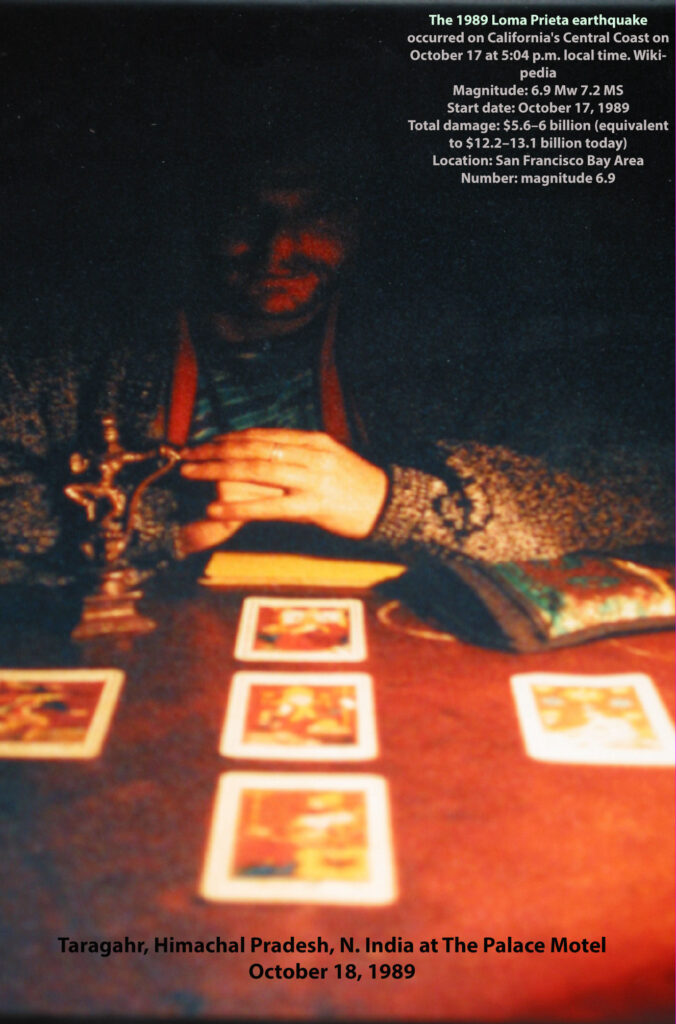
I was stunned by the response. In the next fifteen minutes, virtually everyone in the group (except Padre, due to certain professed dharmic obligations I never quite understood) approached me and requested a Tarot appointment as it were. I jotted down 20 minute intervals in my notepad, and told all querents to meet me at the small round corner table past the tiger skins at the very end of the long downstairs corridor at their scheduled times. I knew something important would come of this for I trusted that under such extremely paradoxical conditions–Tarot would prove the final refuge. Shivers now run from my spine when I think of magic that would thus run its course.
Part 3—Mountains Were Again Mountains…
It was the best of times, it was the worst of times, it was the age of wisdom, it was the age of foolishness, it was the epoch of belief, it was the epoch of incredulity, it was the season of light, it was the season of darkness, it was the spring of hope, it was the winter of despair, we had everything before us, we had nothing before us, we were all going direct to heaven, we were all going direct the other way–in short, the period was so far like the present period, that some of its noisiest authorities insisted on its being received, for good or for evil, in the superlative degree of comparison only.
Charles Dickens, A Tale of Two Cities
The Table
A small black-lacquered round table sat alone at the far end of the long downstairs corridor, an ideal “divination zone” I thought, and so it was there that I set my things and prepared for the experiment. With my back to the end wall, I positioned a second chair at the table directly opposite me so to best assure privacy and quietude for our card games to follow. To my left, I placed a small statue of Vishnu, “The Preserver,” as reminder of his benign and fathomless reach of protection over all worldly creation. Under the circumstances, any help from Vishnu’s couldn’t hurt.
As is my practice of preparation, I then closed my eyes and began pacing my breathing to the rhythmic and steady procession of concentrated shuffles of the cards, sending a continuous percussion of claps and swooshes echoing down the long hallway. Generally speaking, the more trivial a questioner’s concern, the more ridiculous the entire “divination process” appears—as, for example, “Bologna for lunch?” posed the oracle would seem hardly worthy of such transcendent focus. The flipside, however, is equally true: the more crucial and indispensable the issue under consideration, the more it seems absolutely natural and necessary for this preliminary phase of the divination process. One senses the mandate to go slow and deep, mindful that great consequence arrives potentially with the turning of even a single card.
Cartomancy or divination by cards, like other forms of religious rites and ceremony, invites a certain willingness to engage the symbolic imagination with genuine sincerity, beginning in this case with preparations. As such, in my mind (even, if only in my mind) the cards were a collection of rare and beautifully illustrated treasure maps of consciousness, each card a necessary and distinct carrier of the pristine and essential coordinates of higher intelligence, though encoded in an esoteric symbol system of perennial wisdom. I imagined, as well, that in the act of blindly shuffling and reshuffling their sequence I was replicating the mysterious and seemingly random operation of karma, the hidden process that pervades and shapes the natural unfolding of events, and in turn, stamps each individual existence with certain higher challenges and directives for spiritual gain and loss.
To elevate the concentrated practice to the heights of our current surroundings, I added a simple centering mantra offered between each shuffle and breath, wherein the heart of compassion was invoked in the soothing Buddhist chant of The Four Metta Phrases: “May All Beings Be Happy” (clap, swoosh, cut, breathe)…“May All Beings Be Protected” (clap, swoosh, cut, breathe)… “May All Beings Be Peaceful” (clap, swoosh, cut, breathe)…“May All Beings Be Liberated” (clap, swoosh, cut, breathe)… and so on. The syncopated procedure filled the gaps before, between, and after each appointed reading, even if only serving to cleanse and refresh my own body and mind for the long evening. I hoped to generate sufficient energy for the considerable challenge before me: transmitting the wisdom of Tarot toward crucial matters of hope and despair, life and death, mountains and valleys.
First Blood
On cue as I broke from the preliminaries, I spied my first subject making her way down the long-tiled corridor, pausing briefly by the hanging Bengali tiger skins, and then down to the divination zone at the very end. Smiling, but walking heavily as was not her custom, I raised a welcoming hand and motioned her to sit on the chair across from me. “Welcome to the divination zone,” I said. “J” was herself an esteemed and quite likeable member of the teaching staff, an accomplished traveler, author, and spiritual teacher in her own right. What better “test case?” I thought. As she sank in the chair, I could see the underlying emotions quickly rise to her face and eyes that now seemed aged in their weariness, grief, and anxiety. I suggested simply that we let all the madness hang out unchecked, and try to sort some things out using the tarot cards. See what happens.
J. simply nodded. I inquired whether there were any specific questions or concerns to address? Her short, strained smile gave way to the knot now tightening below the surface. “No, not really,” she sort of winced, “there’s just so much to process I don’t know where to start really.”
“My house is very near the fault line in Berkeley—I know because we just put it up for sale a month ago and the realtor said as much…(pause). My daughter’s staying in the house now, she’s taken a semester off from college, and she’s watching over my mom who’s 86 years old and has diabetes and other ailments, and is generally in very poor health…And then, petty as it sounds, there’s the matter of my nearly finished manuscript sitting on the old living room desk–the product of five years of research and grueling writing, and…it’s all woven together like some horrendous nightmare … or I guess that’s simply the way life is, you know?”
I nodded. She was right, of course. Everything that matters is stuck together in karmic molasses. Tarot readings certainly make that abundantly clear. Now J’s deeper feelings began spilling to the surface. Choking down tears, she cried out: “I just hope everyone’s alive and ok, that’s all…that’s all that matters. I’m really, really frightened Art.” I was pleased that we were getting down to business.
It would be similar for everyone who came into the zone that evening, given the cruel reality that no further information, no answers, no response, no exit would be forthcoming for at least another day. A lifetime, it seemed. We were left simply to stew, as the saying goes, in our own juices. I tried to remind myself that this is often the very best way to cook a really fine meal. Stew in your own juices, the way of the pressure cooker. J’s real question was now ready for articulation. She put it squarely: “How should I hold this mess now? What is my lesson here?”
The Spread
Given that only the Higher Keys were at hand, that is, the twenty-two trumps of the Major Arcana, I chose a short five card layout (once gleaned from the Jungian analyst John Bebe) that was designed specifically for using with the trump cards exclusively, wherein the fifth and final position is determined by a numeric reduction of the first four cards. For example, should the divined first four cards be Trumps II (Priestess), IV (Emperor), VI (Lovers), and VIII (Justice), one simply adds these numbers (2 + 4 + 6 + 8) to get the sum of 20 (Trump XX, Judgment), which subsequently becomes the fifth and final card of the reading. The Fool (retains its zero value in calculations) but occupies as is customary the final deck position as the 22nd card. Sums exceeding 22 (and therefore bearing no direct trump analogue) are further reduced to their single digit root, thus 23 = 5 (i.e. 2+ 3) or Trump V (Hierophant) and so forth. The configuration and fixed positions were thus set in following pattern:
Configuration:
| 3.TheKnown | |||||
| 1.WorkingFor | 5. Now Needed | 2. Working Against | |||
| 4.The Unknown |
A Cauldron of Happenstance
Like all things, a tarot reading never operates in a vacuum. One’s karma, or cauldron of interconnected factors that directly, and at times indirectly, contribute to the shaping of momentary situations and circumstances always exist in the mix. Though an identified issue draws focal attention, the subtler ingredients often lie hidden beneath the surface like spices within the broth. Divination is the large stirring spoon that animates what’s underneath so that certain hidden elements temporarily bubble up to the surface. The pot, I might further posit, is Nature herself, or more simply, the way of all things in the cosmos. Below is synopsis of J.’s reading.
Query: How should I hold this mess now? What is my lesson here?
1. Working For: The Fool (0)
2. Working Against: The Star (XVII)
3. The Known: The Priestess (II)
4. The Unknown: The Emperor (IV)
5. Now Needed: The Hierophant (V)
Synopsis:
In Position 1–Working For, The Fool (Trump XXII). Signifies: fearlessness, sense of wonder and openness, beginner’s mind, spirit of innocence, play, and discovery. In context, the image was one of permission to disengage—in particular, from the dire and despairing mood that had swept over us all. A forgotten ally, The Fool basically counseled—“It is to your advantage to stay in the moment, to remain open and present, fearless if foolish. Better to play than fret.”
In Position 2—Working Against, The Star (Trump XVII). Signifies: emergence, enlightenment, guiding light, inspiration, hope. In context, the image actually discouraged conscious spiritual focus, or taking refuge in hope or inspiration, etc. No prayers for light and salvation just yet, it suggested. Better to stay with The Fool, perceive emptiness, remain open to the moment, do nothing. The Star appears like an untimely prayer or an unskillful remedy. It counsels: “Now is not the time for replacing despair with its opposite. Let go of that. Remain The Fool, without attachment to loss or gain, as positive efforts may actually be a hindrance at this time.”
In Position 3—The Known, The Priestess (Trump II). Signifies: deep memory, intuitive knowing, subtle wisdom, forbidden secrets. In context, the image reflects J’s own spiritual awareness as a teacher and advanced practitioner, in particular, of the subtle forces of mind and intuition. “Here you are considerably accomplished” it counsels, “remember who you really are and bring this knowledge to bear now.”
In Position 4—The Unknown, The Emperor (Trump IV). Signifies: order, structure, command, the father principle. In context, the image suggests circumstances are still forming, unknown and uncongealed, fluid but in process. As such, response is premature, command uncertain. The Emperor cautions: “You can’t take charge at this time because nothing is settled or structured. To do so would be folly.”
In Position 5—What Is Now Needed, The Hierophant (Trump V). Signifies: guidance and ethics, bridging the material and spiritual, authority, spiritual instruction. In context, the image suggests the predicament itself is a teacher and teaching. In practical terms, J. must return to her designated role as Buddhist instructor and perhaps hold this predicament as a lesson of impermanence, and a teaching for others. In the role of teacher, J. herself must bridge the spiritual work with the situation at hand.
Out From The Zone
By nine p.m. my divination zone had become the most trafficked corner of the Palace of Taragahr. Besides the scheduled individuals who made their way to the tarot table, a loose congregation of “querents-in-waiting” and the “cartomantically-curious” were now sort of filling up the floor space of the outer zone. I suspect because only here–within the ripples of Tarot—was fresh intelligence and perspective readily available. All conventional lines of communication were currently “down.”
This is not surprising given that the wheel of Tarot rotates outside the phenomenal wall of time and space and outside the filtered beliefs and constructions of conventional wisdom; Tarot as we’ve discussed previously is uniquely immune to the comings and goings of human invention, and it is not merely fashionably anachronistic, it operates outside of time entirely. Like water, it is neither fixed nor alive, yet fills any container and nurtures and replenishes life. As a beverage for Earthly beings, water is neither rare nor expensive, tasty or intoxicating, nor is it even naturally bubbly–yet for quenching thirst nothing is better. In purposes of thirst for meaning, in every respect, Tarot is much the same.
By her own reporting, J’s reading had been invaluable, though in all honesty no more or less remarkable than the eight or nine others of that evening before closing shop for the night. Each reading that followed, in fact (or at least, in perception, theirs and my own) was similarly direct and timely, not especially “magical” as perceived from the outside, but indeed anchoring and elevating within the recipient’s experience.
The night was getting late, I was about tapped out emotionally, but intrigued enough by the results to attempt one final reading, my own. Rather than a personal question, I thought a larger question would be interesting—“How can all beings benefit in the future from the lessons of today?” After so many personal stories, I was hankering for something global. The following cards emerged:
Query: How can all beings benefit in the future from the lessons of today?
1. Working For: Wheel of Fortune (10)
2. Working Against: The Sun (XIX)
3. The Known: The Priestess (II)
4. The Unknown: Hanged Man (XII)
5. Now Needed: The Chariot (VII
Synopsis:
In Position 1–Working For, The Wheel of Fortune (Trump X). Signifies: timing, change, cycles, karma, luck, and destiny. In context, the image affirms the fact of impermanence and the cyclical nature of change. Crises may actually benefit beings, the card suggests, when learning to flow harmoniously with change becomes the only option. As such, change (even that borne of crisis) holds hidden opportunities. Beings will benefit by taking advantage of such opportunities.
In Position 2—Working Against, The Sun (Trump XIX). Signifies: consciousness, activity, energy, power. In context, the image discourages a conscious and active response at this time, underscoring the better strategy of adjusting (like water) to change rather than responding to it actively. More benefit is found in riding the horse in the direction he’s going rather than by overpowering or consciously attempting to direct it.
In Position 3—The Known, The Priestess (Trump II). Signifies: deep memory, intuitive knowing, subtle wisdom, forbidden secrets. In context, (as in J’s reading), the image suggests the answers exist within and are already known (but forgotten); beneath the veil, the forbidden secrets are accessible only through intuition. As one remembers this original nature, this lost innocence, one’s natural intelligence can be applied to the complexities of worldly concerns.
In Position 4—The Unknown, The Hanged Man (Trump XII). Signifies: surrender, detachment, awareness, dis-identification, suspension, witnessing. In context, the image suggests a hidden talent and strategy—the crucial piece which completes the puzzle, namely, awareness. The ability to be sufficiently ego-detached (during crises) to suspend the instinctive urges of self-preservation; the ability to witness and observe events without reaction is the necessary talent that brings great benefit to all beings.
In Position 5—What Is Now Needed, The Chariot (Trump VII). Signifies: pursuit, quest, directed action, communication, global intent. In context, the image describes the need for new global attitude of spiritual pro-action, a quest that includes penetration of the laws of change, awareness, and the strategy of detachment. A mandate that at once overpowers all doors of limitation in its urgency yet retains the above-suggested wisdom virtues. Disaster precipitates the wake-up call for this unambiguous call.
The Catalyst Experience
Imagination, right? Beautiful ideas pickled in sweet thoughts and fantasies? Naturally, as we all know today, imagination, fantasy, and sweet ideas as such have no measurable impact in the real world. Perhaps…
The same cannot be said, however, for imagination, fantasy, and horrible ideas which have been the driving force behind countless man-made disasters such as the Holocaust, Waco and The People’s Temple, and more recently [Ed. Note: at the time of this writing] the World Trade Center attacks, to name a few. Strangely, it seems more palatable in our age to attribute the powers of mind to negative and misguided outcomes. Invariably, deranged thinking is credited as the final source of human tragedy and folly. But what of human triumph? What of the powers of transformative thinking? In our tale, through the skillful access and application of imagination, all individuals left the table significantly calmed and softened, hopeful and energized, spacious and reflective, and though difficult to quantify, somehow “matured” or “enhanced” in personality as if by some magical rite of passage or initiation. This even though, of course, nothing in the outer circumstance had changed at all.
Perhaps these effects were due simply to the suggestive powers of the Tarot images themselves, not to mention the complex circumstances under which they were given. Still it cannot be denied, given the extraordinary angst that had toppled our psyches, that to create such dramatic psychological turnaround in so short a time is indeed noteworthy. Imagine, for a moment (without out regard to logistics), that similar results could be experienced by significantly greater numbers of people– in response to still larger and more shocking or difficult events–such as the aftermath of 9/11 or perhaps the intractability of the Israeli-Palestinian conflict?
The social scientist, no doubt, will quickly discredit such “magical” effects as mere “flights into health” owing to various “suggestibility” factors present, as in our case within close-knit survivor groups undergoing high degrees of ambiguity and uncertainty in response to potential catastrophic outcomes befallen loved ones, which by chance and circumstance, subjects had themselves escaped. I believe strongly, however, that the social scientist will miss an important opportunity in such reductions.
The scientific explanatory route will miss the true experience that was imparted via divination on that day. It will miss something far larger and more mysterious that operates in the unfolding of events—a subjective dimension of symbolic meaning that can, in terms of motivation and desire, potentially move mountains. Missed will be an appreciation of the transformative potential of imagination, which in turn will lead to the bypassing of the psychological and spiritual enhancement that comes experientially in the face of critical events, whether natural or man-made, via symbolic exploration.
This is what I call “the catalyst experience,” which in our Tale Of Two Cities was the raw circumstance of paradox and powerlessness that forced the hand of divination. The scientific explanation, however, will bypass this “catalyst experience” as an opportunity to contain and redirect pregnant emotion charged with urgency and immediacy. Subsequently, it will bypass the potential insight that naturally emerges in human beings when powerful events are initially explored symbolically, synchronistically, and imaginatively, the deep insight that is required for real transformation.
Lacking authentic insight, the human tendency for reaction and countermeasure, with its contradictory adherence to both reasoned response filtered through the primitive emotions of self-preservation, in other words—business as usual—will continue the downward spiral. This self-defeating counter-response to critical events is happening today at far greater velocity. Individuals, societies, and global powers have quickened their blind march of reasoned reaction and unconscious fight or flight, founded, as the Buddhists say, on the circular thinking of hatred, greed, and delusion,” with no regard for the potential power and intelligence of the human imagination. In the capitals of the world, this self-defeating modus operandi is given a name: “leadership.”
Our Tale of Two Cities, ultimately, is about no more than a catalyst experience, one that by its uniquely paradoxical nature had eliminated the temporary shelters where refuge from impending danger are nestled. There was no place to hide, no exit, from perceptions collected in one compelling though ultimately misperceived window of time. We were left simply to stew in our own juices. A blessing in disguise it was, and the perfect opportunity to enter another zone of possibility, where in the end by virtue of this extraordinary false alarm, born of natural causes, mystical mountains, and furthered by power outages, misinformation, human imagination, and historical precedent, all told a really fine meal of magic and pending disaster was cooked to perfection to deepen our appreciation of the mysterious nature of all phenomena.
-Arthur Rosengarten
Readers: please email me if you enjoyed this true tale with your comments. It will inspire me to post other, equally interesting magical travel tales I have experienced and written about over the past 40 years. drartrosengarten@gmail.com